
Key Takeaways:
- EPA’s pesticide data is split across six separate databases.
- Electrolux and others have paid six- and seven-figure penalties for registration errors.
- Ongoing monitoring is necessary to keep the product compliant.
The EPA doesn’t have a single database. Instead, it splits all vital pesticide information across a handful of separate databases.
Each of those comes with its own quirks and its own learning curve. Navigating this system can definitely be a challenge.
To untangle it all for you, this post breaks down the key systems that make up EPA’s Pesticide Data System, and what they all mean.
Key Databases Within EPA’s Pesticide Data System
To navigate this maze, you will have to get familiar with a whole host of separate systems, each covering its own slice of the picture: active ingredients, product labels, registration status, inert ingredients, and more. Get any of it wrong, and the stakes can get real very quickly.
For example, Electrolux paid nearly $7 million in penalties after its Frigidaire dehumidifiers and air conditioners were sold with antimicrobial claims that, it turned out, required pesticide registration the company never obtained.
Here’s a quick look at each database.
Pesticide Product Information System (PPIS)
PPIS is the foundational record of every pesticide product registered in the United States.
For each product, it tracks:
- registrant’s name and address
- chemical ingredients and their toxicity category
- product and distributor brand names
- sites and pests it’s approved for
- formulation code
- current registration status
That covers both FIFRA Section 3 registrations and Section 24(c) Special Local Need registrations, the state-specific approvals granted for uses not covered under a product’s federal label.
Seems all well and good, right? Well, the catch is how this data is delivered.
PPIS data comes in raw ASCII files, a text format dating back to the 1960s. In other words, there’s no modern search interface here.
To actually work with the data, you need your own database or spreadsheet software to import and query it. For manufacturers, this makes PPIS less of a lookup tool and more of a raw dataset: useful for building your own internal registration tracker, but not somewhere you’d go for a quick one-off check on a single product.
Pesticide Product Label System (PPLS)
PPLS is the official archive of every approved pesticide label in the U.S.
This database houses over 170,000 current and historical labels, all converted into text-searchable PDFs.
You can search it in four ways, including by:
- product or brand name,
- chemical name
- company name
- EPA registration number
Since products sometimes change hands, PPLS also tracks the full transfer history when one company sells a registration to another.
For a manufacturer, it’s often the fastest way to confirm exactly what a competitor’s (or your own) approved label says, without digging through older, possibly outdated versions.
Still, it’s advisable to maintain a reasonable degree of caution: “approved” doesn’t always mean “correct.”
One study of pesticide labels found that 31.5% of them contained at least one error in how they communicated a specific mandated disclosure.
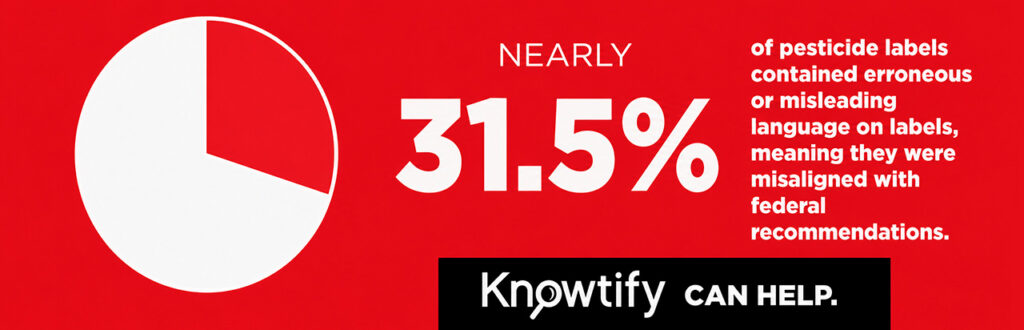
If you’re using PPLS to model your own label language after an existing approved one, that’s a reminder to verify the underlying data yourself rather than assume approval equals accuracy.
Pesticide Data Submitters List (PDSL)
PDSL solves one specific problem: figuring out who to pay when your registration relies on data that another company has already submitted to the EPA.
Under FIFRA, if you cite another registrant’s existing studies rather than generating your own, you’re required to pay that company compensation. PDSL is how you find out who to contact. Here’s how it all works:
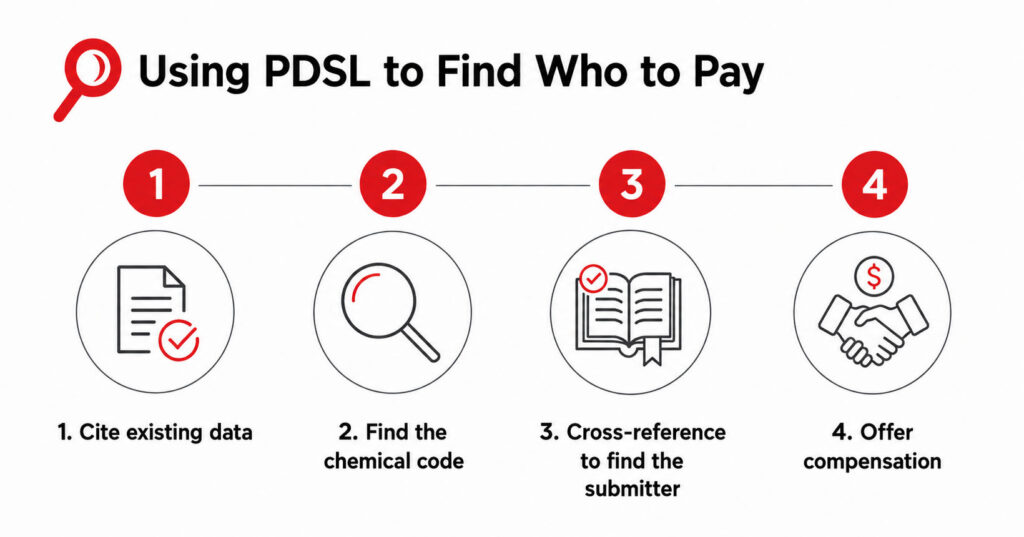
For years, this meant downloading two dense PDFs:
- one listing companies by a six-digit chemical code
- and another cross-referencing chemical names to those codes.
Luckily, the EPA has since introduced an online version of PDSL, updated monthly, letting you search directly by chemical name, company name, or company number instead of hunting through static files.
The older PDF-based files are still the official record, though, and are worth checking directly if you need to confirm a chemical code or an exact compensation category (efficacy, toxicology, residue chemistry, and so on).
Active Pesticide Product Registration Informational Listing (APPRIL)
APPRIL is the newest of EPA’s pesticide databases, launched in August 2022, and it’s built to be more flexible than the others on this list.
You can search it by registration number, product name (including wildcard search), company number, company name, active ingredient, registration date range, or a combination of sites and pests.
It’s also updated daily, covering both active and cancelled Section 3 and distributor product registrations.
That flexibility comes with a learning curve, though.
For example, EPA’s own user guide for APPRIL recommends using browser zoom shortcuts just to fit the results table on screen, since it’s often too wide to view normally.
It also warns against combining certain search methods in the same field to avoid producing confusing results.
For manufacturers, APPRIL is genuinely useful as a one-stop status check, especially since it links directly back to PPLS for the corresponding label.
Just budget a little time to learn its quirks before relying on it for anything urgent.
InertFinder
InertFinder emerged in 2011 after years of industry requests for a single, searchable home for approved inert ingredients, rather than hunting across scattered lists.
Search by chemical name or CAS number, and it sorts results into three categories:
- food and nonfood use
- nonfood use only
- Fragrance Ingredient List for approved scent components.
Those categories tell you where an ingredient is cleared for use, but not how risky it is.
The word “inert” itself is misleading in that sense: in a 2021 study cited in a recent academic analysis, a single inert coformulant found in the fungicide Amistar killed 30% of the bees exposed to it in testing. InertFinder confirms approval status, not safety.
Two related resources round it out.
The Commodity Inert Ingredients List designates certain common, low-risk chemicals that manufacturers can source from any supplier without disclosing a specific supplier’s name on their formula statement.
The Trade Name Inert Ingredient Database, meanwhile, is a voluntary listing of commercial ingredient mixtures.
Pesticide Chemical Search
This one is a little different than the rest.
Chemical Search doesn’t hold new data of its own.
Instead, it consolidates existing information scattered across EPA’s Office of Pesticide Programs website into a single searchable portal, organized by active ingredient.
Enter a chemical name or CAS number, and you’ll get access to over 20,000 regulatory documents (fact sheets, Reregistration Eligibility Decisions), links to more than 800 open dockets on Regulations.gov, and the chemical’s current status in EPA’s review pipeline.
It’s especially useful for spotting whether a given active ingredient has an open public comment period – something manufacturers, regulatory teams, and even advocacy groups actively track, since a registration can hang in the balance. Dicamba, a selective benzoic acid herbicide, is a good example of just how high those stakes can get.
EPA opened a public comment period in July 2025 to re-approve the product for the third time, after federal courts had already vacated its registration twice, once in 2020 and again in 2024.
George Kimbrell, legal director at the Center for Food Safety (one of the groups behind the earlier challenges), believes “it is both irresponsible as well as unlawful for the EPA to issue an approval for the third time for this broken product.”
Anyone tracking Dicamba’s active ingredient in Chemical Search that month would have seen exactly this playing out: an open docket, a heated public comment period, and a paper trail stretching back years.
In other words, you can regard it as a useful source of competitive intelligence if you check it regularly.
Why Access to Accurate Pesticide Data Is Essential for Manufacturers and Distributors
None of these databases exists for its own sake. They have to be used in tandem.
Get your registration status wrong, or miss a label update, and you’re not just risking having to do more paperwork.
Tzumi Electronics and Enchante Accessories learned this firsthand, paying $1.5 million in penalties after their UV pesticide devices were found misbranded.
Compliance doesn’t stop once you’re registered, either.
Labels get amended, ingredients get reassessed, registrations get cancelled. Whether you like it or not, you simply have to perform regular checks against PPLS and APPRIL to catch regulatory updates that render your product non-compliant before an inspector does.
There’s a business case here, too. Tracking which active ingredients are nearing approval or which competitor registrations are lapsing turns this data into invaluable competitive intelligence.
The common thread: treat this data as a checkbox, and you’ll find out the hard way that it wasn’t one.
Knowtify: A Better Way to Navigate EPA Pesticide Data
As we’ve seen, each database has its own quirks, formats, and blind spots. Working with them all can be difficult, if not outright frustrating. Knowtify has been built from the ground up to eliminate those frustrations precisely.
Our software consolidates federal and state pesticide registration data into a single searchable interface, pulling updated EPA records roughly every two weeks.
Instead of manually rechecking PPLS for label changes or cross-referencing APPRIL for a competitor’s new registration, our alert system lets you set up a profile based on your specifications and filters. When something noteworthy happens, you get informed straight away.
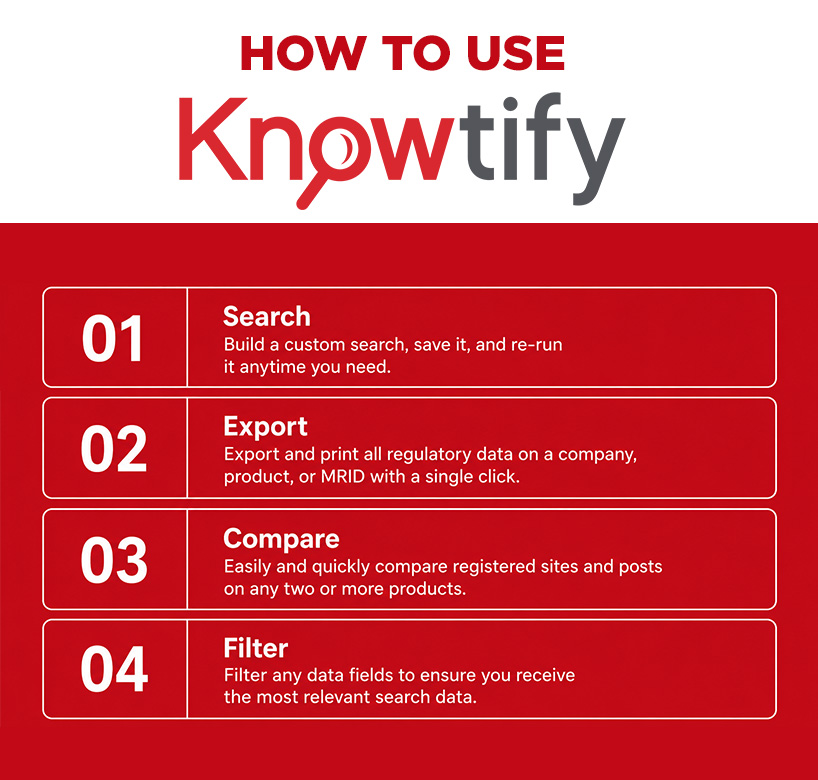
Our features cover more than your own portfolio, too.
Regulatory teams can track labels, brand managers can watch competitor filings, and sales teams can spot new market entries, all from the same underlying data, without needing separate exports or manual spreadsheet work.
Conclusion
The challenge most manufacturers and distributors face doesn’t pertain to a lack of information.
The data is out there. It’s abundant, even.
But it’s laborious to rifle through, especially when one wrong move risks a regulatory infringement and costs you time and money.
Of course, it would be better if PPIS, PPLS, PDSL, APPRIL, Chemical Search, and InertFinder were consolidated into one single resource.
However, that future remains a pipe dream. For now, all you can do is build a habit of checking each database for updates early and often, or let a platform like Knowtify do that for you.