
Key Takeaways:
- 70% of cases that complete EPA’s review result in new risk mitigation requirements.
- The EPA has various registration processes for different pesticide products.
- Getting the EPA approval doesn’t mean you can sell your product across the US.
EPA pesticide registration is more unforgiving than many manufacturers expect.
Mistakes can set your timeline back by months, result in rejected applications, or trigger enforcement actions carrying civil penalties in the hundreds of thousands of dollars.
Most of these mistakes share a common thread: they were avoidable. This article covers six of the most common ones, along with what you can do to steer clear of them.
Choosing the Wrong Registration Pathway
The EPA does not have a single registration process for all pesticide products.
What you need to do depends on what you’re registering, how it works, and how similar it is to products already on the market.
Products are reviewed by different divisions within the EPA’s Office of Pesticide Programs depending on their type. As such, the pathways to registration and being allowed entry and distribution on the market differ for all of the following categories of substances:
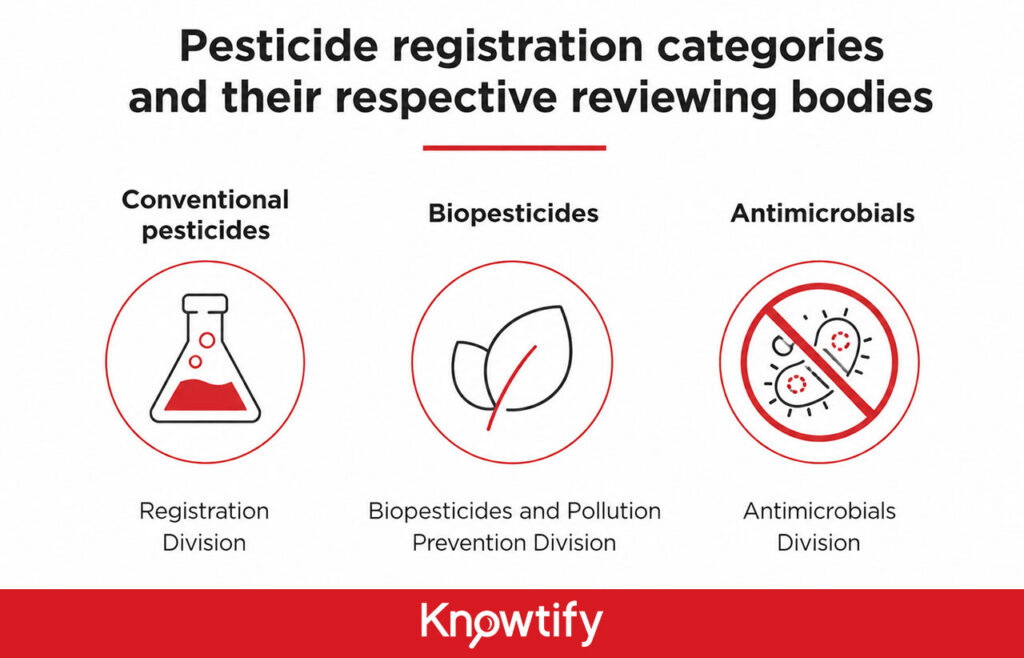
Misclassifying your product at this stage means your application lands in the wrong place, and the data you’ve prepared may not match what that division expects to see.
Beyond product type, the pathway you take also depends on how novel your product is.
Here, the EPA also subdivides its procedures further:
- Products containing new active ingredients have the most extensive data requirements.
- Existing products seeking approval for new use cases sometimes have lighter procedures
- Substantially similar or identical products (formerly known as “me-too” products) are much easier to register on account of existing studies
- Devices that control pests by physical or mechanical means, such as ultrasonic repellers, have their own classification under FIFRA and do not require EPA registration
On the other end of the spectrum, there are also products classified as minimum risk pesticides that don’t require federal registration at all.
In such cases, choosing to pursue full federal registration wastes significant resources.
That’s not where the fringe scenarios end, either.
If the product is intended for use on food or feed crops, an additional layer applies. To issue an approval for such products, the EPA must establish a tolerance under FFDCA before registration can proceed, and the data to support that tolerance needs to be built into the package from the start.
Regardless, for every single case imaginable, the right starting point will always be a studious review of the EPA’s registration manual, particularly:
Do this before beginning anything else.
Submitting an Incomplete or Poorly Structured Dossier
Preparing a submission package that meets the EPA’s expectations is where many applicants run into serious problems.
A common mistake is submitting a package with missing studies, poor organization, or formatting that doesn’t align with EPA or OECD standards.
The consequences are significant, as pesticide registration applications cannot be amended once submitted, and errors have to be resolved through formal EPA information requests. Depending on how far into review the application gets when problems are found, the consequences range from outright rejection to a 75-day response window before the application is treated as withdrawn.
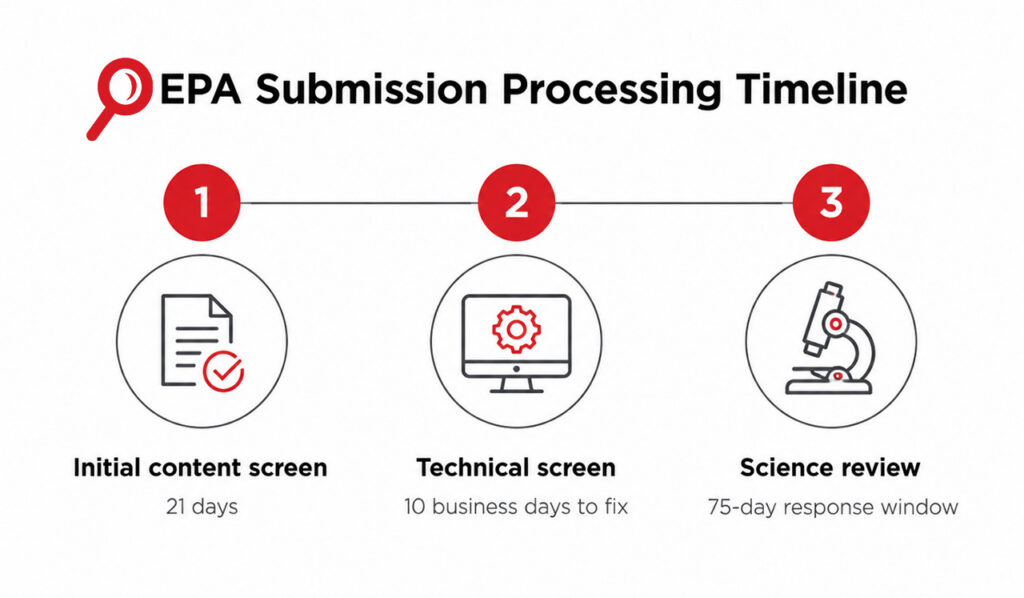
The package must also include a Confidential Statement of Formula, a document which discloses the full composition of the product, including the active and any inert ingredients.
Applicants tend to get tied up in the other minutiae, and this then catches them off guard quite easily.
Because data requirements are assessed on a case-by-case basis, a checklist built for a previous registration may not apply to the current one.
As such, make sure to always review the EPA’s data requirement guidance specifically as it applies to the product you’re hoping to release.
This way, you’ll be better equipped to identify and address any gaps before the package goes in to avoid delays.
Not Obtaining an EPA Company Number
Before you can do anything with the EPA, you need a company number.
This is a unique identifier that ties all of your submissions, registrations, and regulatory correspondence back to your company.
Without it, you have no legal way to submit a pesticide registration application.
You can obtain yours through the EPA’s Central Data Exchange (CDX) system.
The process starts with setting up a CDX account, and then you submit a formal company number request. It should include:
- Your company name
- Contact name
- Phone number
- Official mailing address
- A signed letter on company letterhead
For foreign companies, there’s an additional requirement: you must designate a US-based agent, since the EPA requires a domestic contact to represent you in all regulatory matters.
Once you’ve got it, it stays with your organization and applies to all future registrations.
It’s also a prerequisite for obtaining an EPA establishment number, which is a separate requirement under 40 CFR §167.20 for any facility that produces, repackages, or relabels a pesticide product.
One last thing: make sure you keep all of this information updated.
If your contact details change and aren’t updated, you risk missing important EPA communications related to active registrations or pending applications.
Putting Forbidden Claims on a Label
Pesticide labeling is governed by strict rules under FIFRA, and there are certain types of claims you simply cannot make, regardless of whether they’re true.
Under 40 CFR §156.10, a product label cannot contain any false or misleading statements about the product’s composition or effectiveness.
False comparisons with other products are prohibited.
So are claims that directly or indirectly suggest the EPA or any other government agency recommends or endorses your product.
Safety-related language is heavily restricted. There are terms that simply are never accepted, even when a qualifying clause like “when used as directed” is added right next to them. Some examples include:
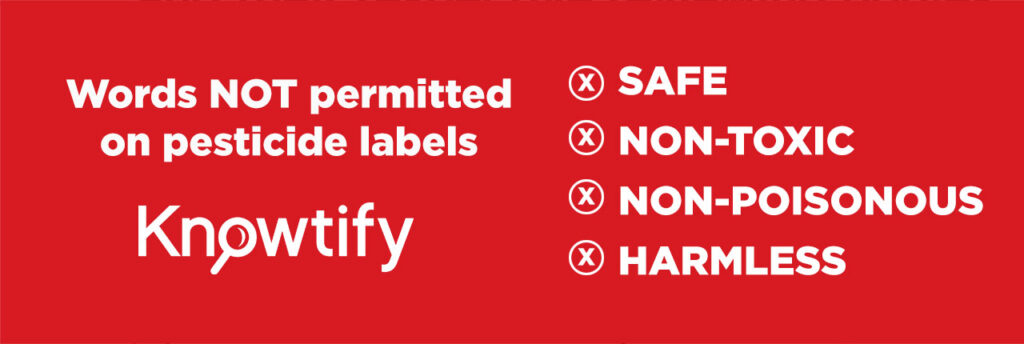
Also, claims such as “contains all natural ingredients,” “among the least toxic chemicals known,” and “pollution approved” all constitute misbranding under FIFRA.
The consequences of getting this wrong can be severe.
Lonza Inc., once the nation’s largest manufacturer of hospital disinfectants, paid more than $550,000 for making misleading efficacy claims about two of its products, one of the largest civil penalties ever assessed under FIFRA.
Grocery Outlet Inc. was fined $392,000 for claiming that a product of theirs was “sterilizing” without prior EPA registration. EPA Pacific Southwest Enforcement and Compliance Assurance Division Director Amy Miller commented:
“Unregistered products claiming to be disinfectants or sterilizers, like the kinds sold by Grocery Outlet in California, can defraud the public and threaten human health.”
Amy Miller
Enforcement and Compliance Assurance Division Director
EPA Pacific Southwest
Quote: EPA
Keep in mind that the EPA also considers your company website, social media accounts, and third-party sales listings to be extensions of your product label.
Non-compliant claims made through those channels carry the same legal risk as non-compliant wording printed on the product itself.
This is a common blind spot for companies whose marketing teams operate independently of their regulatory teams. You really need to stay vigilant here because the EPA enforces all these requirements rigorously.
The most practical safeguard is a pre-approved claims library, or, simply put, a set of vetted phrases drawn from your EPA-approved label language and the relevant CFR provisions.
Make it a point for your marketing and commercial teams (both internal and external) to study them thoroughly.
That one process adjustment should eliminate most of the risk. One other step would be to keep yourself apprised of the latest developments.
Published directly on its website, the EPA’s Pesticide Registration Notices share information and guidance for registrants pertaining to labeling.
Make sure to monitor these updates regularly, as it’s one of the most reliable ways of not falling behind and wasting resources just because a snippet of information slipped under the radar.
Not Securing the Necessary State Registrations
Getting your EPA registration approved is a significant milestone, and it’s easy to assume that upon receiving it, you can just start selling your product across the United States.
Far from it.
Under FIFRA Section 24(a), individual states have the authority to impose their own pesticide registration requirements on top of the federal registration.
Most of them make use of this right.
Whether you hold a valid federal EPA registration or not has virtually no bearing here, and selling or distributing a pesticide product in a state without that state’s registration is a violation.
And a costly one at that, if things get taken to court.
For instance, Amazon agreed to pay the state of California nearly $5 million for selling unregistered pesticides into the state and for unpaid pesticide sales assessments in 2022.
Additionally, state requirements vary, both from EPA procedures and from one jurisdiction to another. To name a few examples:
- California runs its own scientific review process and charges a fee on every sale of a registered pesticide.
- New York has reclassified neonicotinoid pesticides and imposed usage restrictions that go beyond what the federal registration covers.
- Some states require annual renewal of state registrations, with hard deadlines that, if missed, can result in your product being pulled from sale in that state.
As for the differences themselves in practice, they include renewal submission deadlines, supplemental state label compliance, reporting, fee structures, and the data you’re expected to provide, just to name a few.

The practical implication is that state registration planning should begin before or alongside your federal registration process, not after it.
Should you decide to (unwittingly) wait until you have your EPA registration in hand before coordinating with state requirements, you’re likely to realize that you’re suddenly facing an onslaught of extra work you didn’t even know you had to take care of.
That can quickly translate to months of additional work before you can legally sell in key markets.
Treating Registration as a One-Time Event
Some companies fall victim to their own false sense of security after their registration is complete, thinking that their regulatory obligations are finished.
In many ways, it instead marks the beginning of a new set of responsibilities that continue for as long as your product is on the market.
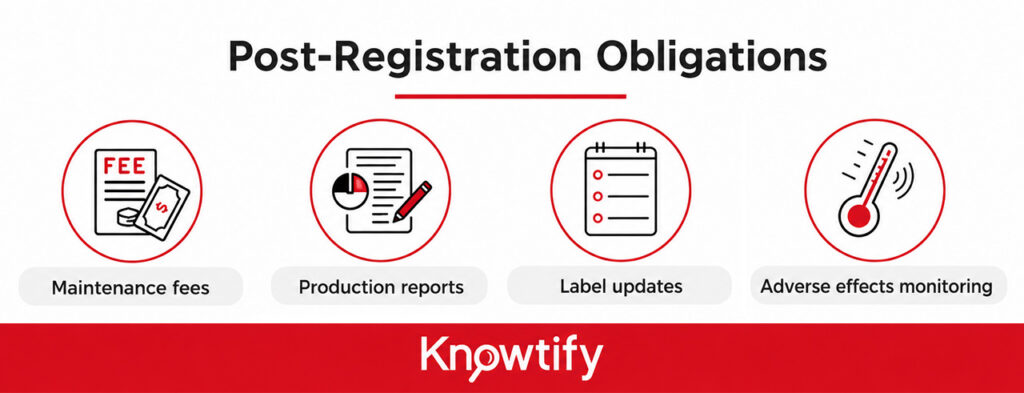
Some of these are recurring annual obligations:
- Annual maintenance fees must be paid to keep the registration active
- Establishments that manufacture or package the product must file an annual production report with the EPA
- Adverse effects associated with the product, involving human health, non-target organisms, or the environment, must be reported to the EPA as they occur
Others are triggered by changes to the product itself:
- If a formula, use site, or target pest changes, the label must be updated and the amendment approved before the updated product can go to market
- Distributor labels must be kept current alongside any changes to the primary label
The regulatory landscape also keeps moving independently of anything a registrant does, and the EPA will re-evaluate every registered pesticide on at least a 15-year cycle. Reviews can (and very frequently do) happen, though, whenever new safety concerns emerge about an active ingredient or use pattern.
These reviews aren’t a formality.
Nearly 70% of cases that complete EPA’s registration review process result in new risk mitigation requirements, whether that’s a label change, a use restriction, or an application limit. In turn, they can place an extra burden on your shoulders and demand you submit new data, modify your label, or accept new conditions on your registration.
And all of this is just the federal, EPA-sanctioned level.
We already mentioned that the state level can barrage you with its own restrictions or reclassification and reregistration mandates.
Staying on top of all of this manually is genuinely difficult, particularly if you have multiple products registered across multiple states. This is where a platform like Knowtify makes a practical difference.

Source: Knowtify
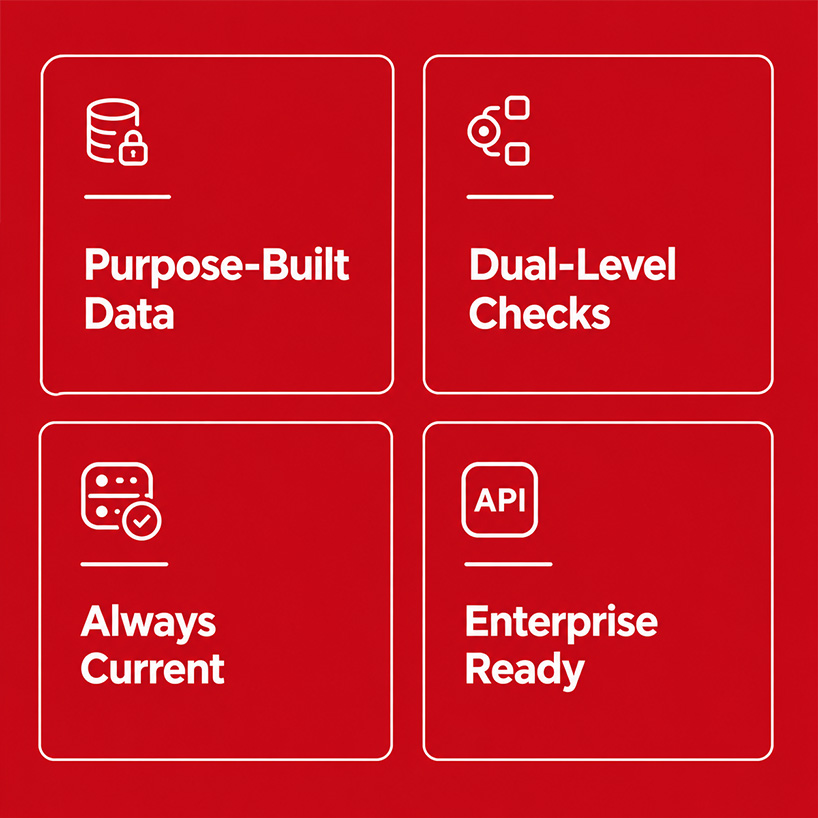
Knowtify is an EPA pesticide registration intelligence platform that transforms complex EPA data into instant, actionable intelligence.
Registrants can obtain real-time access to federal and state-level EPA registration data, product registrations, and labels through a single searchable database, making compliance tracking significantly more manageable than manual methods.
Our proactive alert system sends notifications about regulatory changes and product updates as they happen. That means compliance teams find out about shifts in requirements immediately, rather than discovering them after the fact.
Source: Knowtify
Find out more about how your teams can benefit from enhanced state data tracking and the latest updates on pesticide regulation on both the federal and state levels.
Conclusion
EPA pesticide registration is demanding, but most of the mistakes that create delays or enforcement risk are easily fixed.
That’s because most of them happen when companies move too fast, prepare too little, or assume the process is simpler than it is.
Knowing where the common pitfalls are puts you in a much better position to avoid them. Take the time to classify your product correctly, build your dossier carefully, secure your state registrations, and treat compliance as an ongoing commitment rather than a box to check.