
Key Takeaways:
- Several forms are necessary, covering the product’s identity, its formulation, and the data behind it.
- The label is a legal document in its own right.
- Monitoring regulatory changes continuously is just as important as the registration itself.
Are you preparing to register a pesticide with the EPA and are unsure what actually belongs in the application?
A complete application package is the difference between a smooth review and months of delay.
That’s why this guide will walk you through everything the EPA expects, from the paperwork to the data.
Administrative Portion of the Application Package
The administrative portion of your registration covers the paperwork that identifies your product, confirms your payment, and tells the EPA who to contact. The sections below break down each main piece you need to prepare.
Application Form
The application form is the central document for the registration itself.
It identifies your product and the action you are requesting, and it anchors everything else in the package.
The main form is EPA Form 8570-1, i.e., the Application for Pesticide Registration/Amendment.
The EPA publishes a completed example you can model your own submission on, which helps you avoid simple errors. That being said, the main sections for this form are shown below.
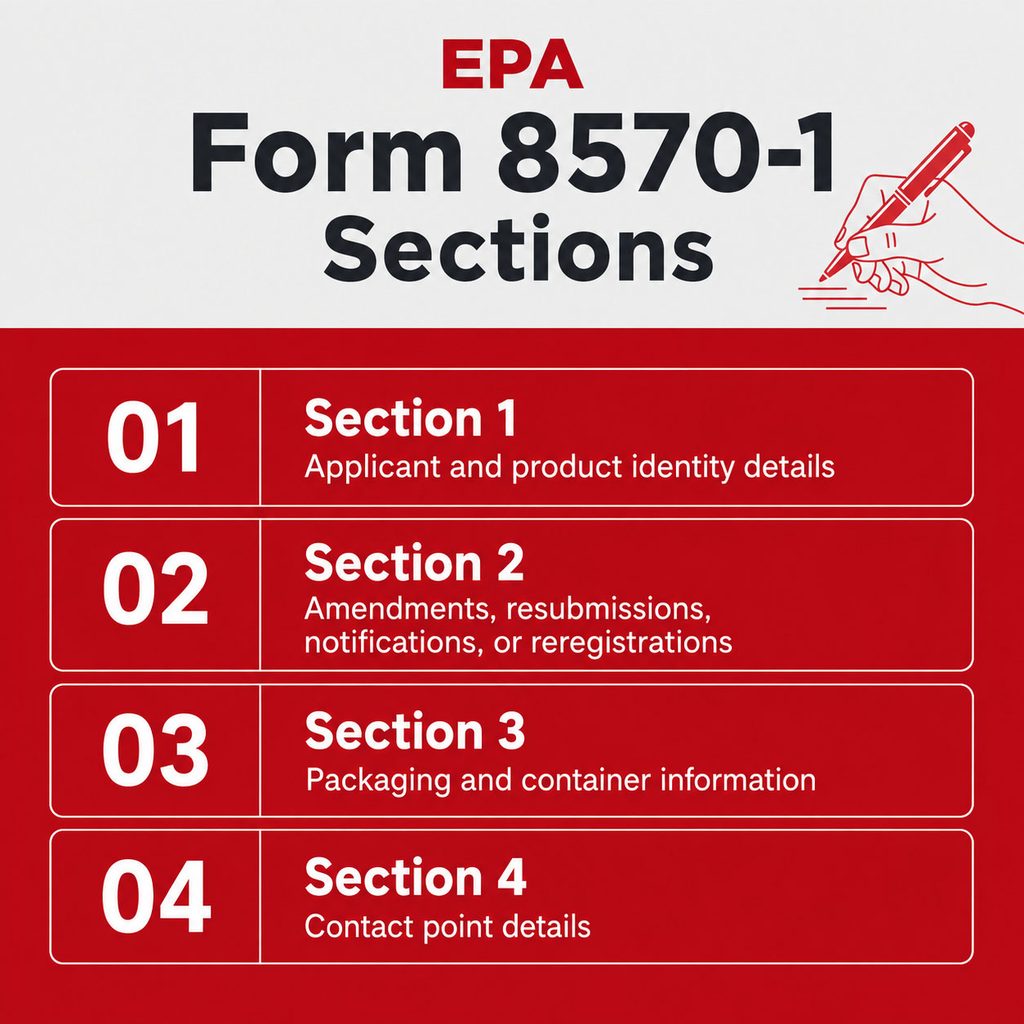
For brand new registrations, the second section might be unnecessary, since it applies to amendments, resubmissions, notifications, and reregistrations.
The remaining sections are straightforward.
You need to establish the identity of the applicant, with the following information:
- Official Company Name
- Address of Record
- EPA Company Number
- Authorized Representative Name & Signature
An applicant who does not reside in the United States must also designate a U.S. agent to act on its behalf, and every applicant must provide a U.S. address for correspondence.
You then provide your product identity details, your packaging and container information, and the contact point for questions. Beyond this main form, a package usually includes several additional forms, shown below.
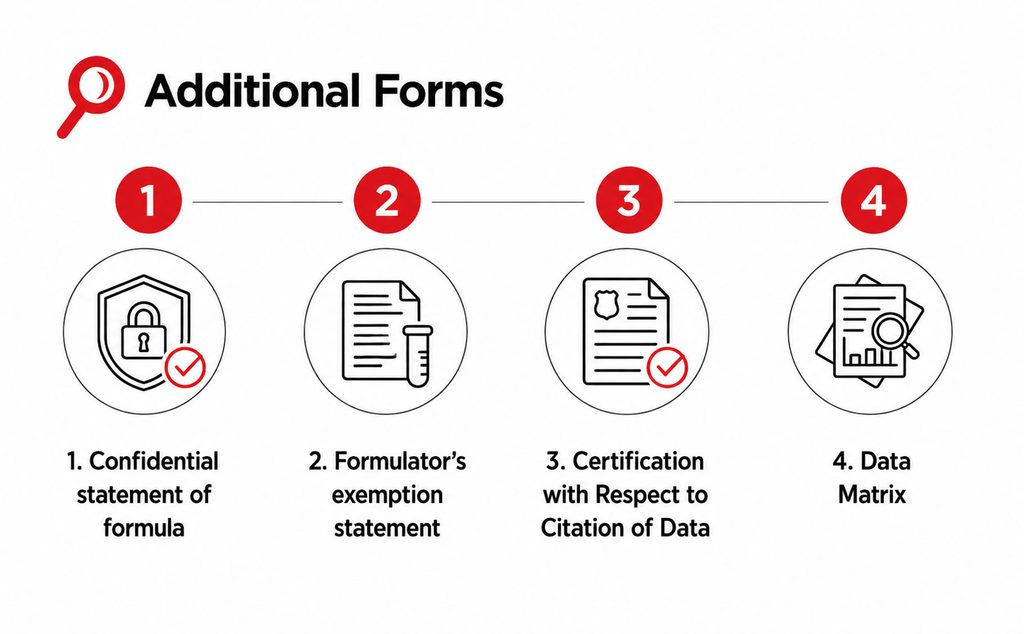
Not all of these are needed every time.
The required documentation depends on the specific nature of your registration, such as whether you are submitting new data or modifying an existing formula.
In fact, most of these forms depend on what is changing, not simply on whether the action is a new registration. Confirm which apply to your specific case, and include only those.
Fee Payment
Every application to the EPA must include payment, and the fee must accompany the package for the review to begin.
Under the Pesticide Registration Improvement Act (PRIA), the amount you owe depends on the specific registration action you are requesting.
There are 226 fee categories to choose from, depending on the registration type and product.
Care must be taken here, because selecting the wrong fee category is one of the more common ways an application stalls.
The decision review period does not start until the EPA receives your application together with the correct fee, so an error at this stage delays everything that follows.
Fortunately, the EPA provides a fee determination decision tree that guides you to the right category. The typical choices you’ll have to make are shown below, though the path branches differently for certain products.
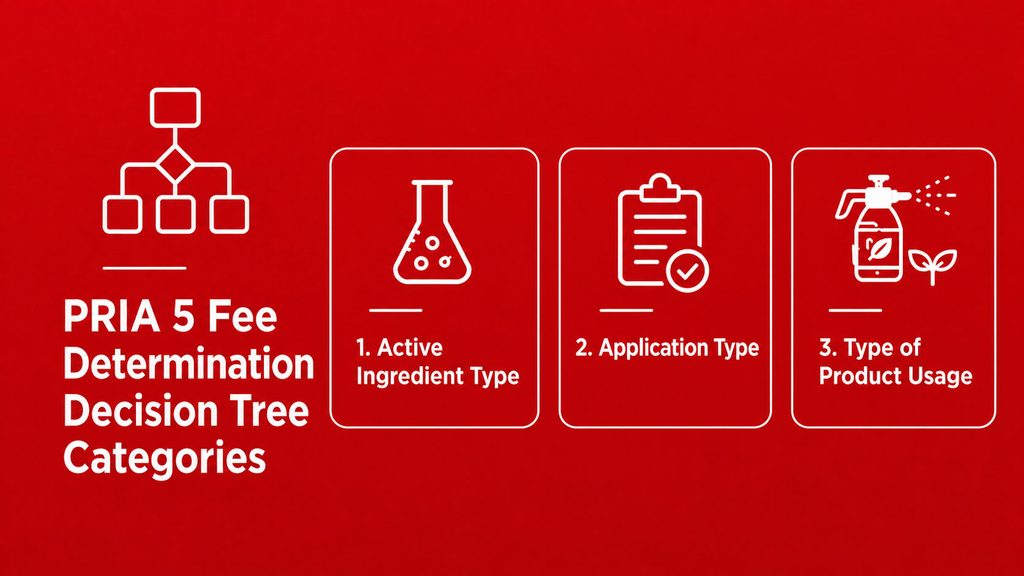
In general, you begin by identifying the active ingredient and the application type, such as whether this is a new registration, an amendment, or another action.
From there, the decision tree branches depending on how your product is used, for example, indoor versus outdoor, or food versus non-food use.
Following these branches leads you to the exact PRIA fee category you need to pay. Shown below is an example of where one path ends, specifically for a new biopesticide registration intended for food use.
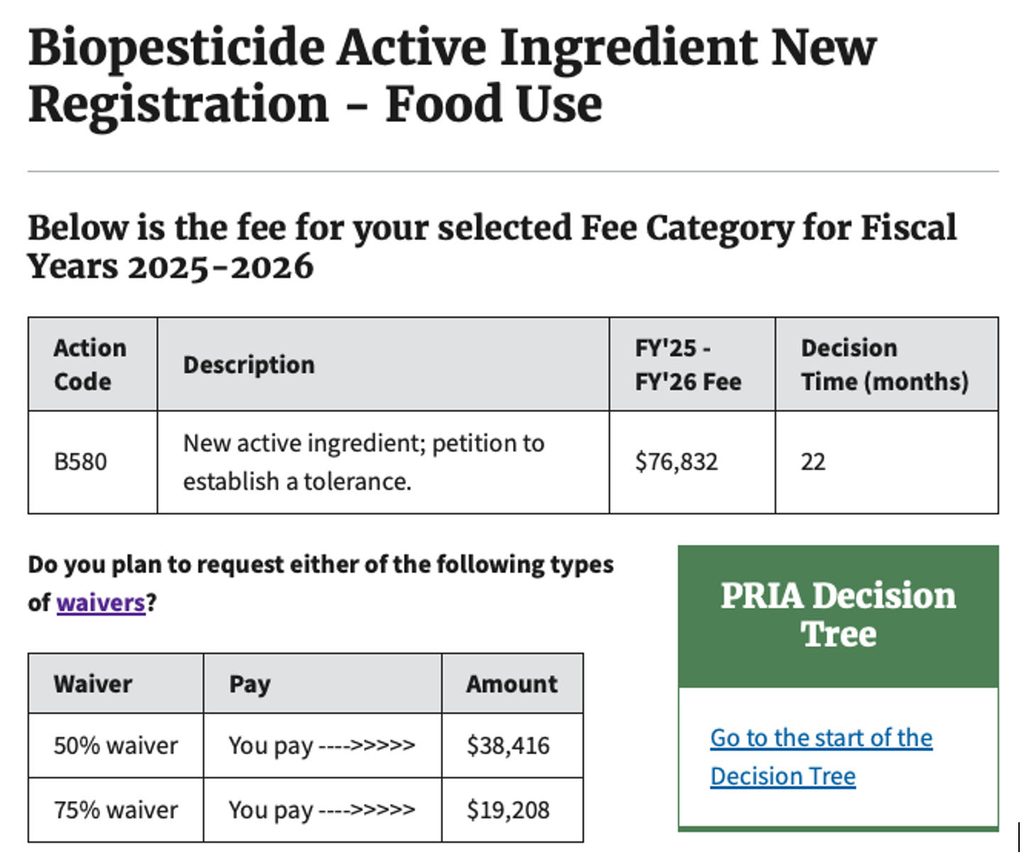
Each category lists a description, the fee for the current fiscal year, and the decision time in months, so you can see the price and the expected timeline together before you commit.
There are also waiver options that reduce or remove the fee in certain situations, including:
- Small businesses
- Products falling under the IR-4 Project
- Applications from federal agencies and state governments
Securing these fee waivers often involves demonstrating specific compliance, so be prepared to provide the necessary supporting documentation in your initial submission to prevent administrative delays.
In short, confirm your category first, then check whether you qualify to pay less.
Optional: Cover Letter
A cover letter is not a required form, but it can help your reviewer understand the package at a glance. The EPA provides an example letter you can follow, with the main sections included in the letter shown below.
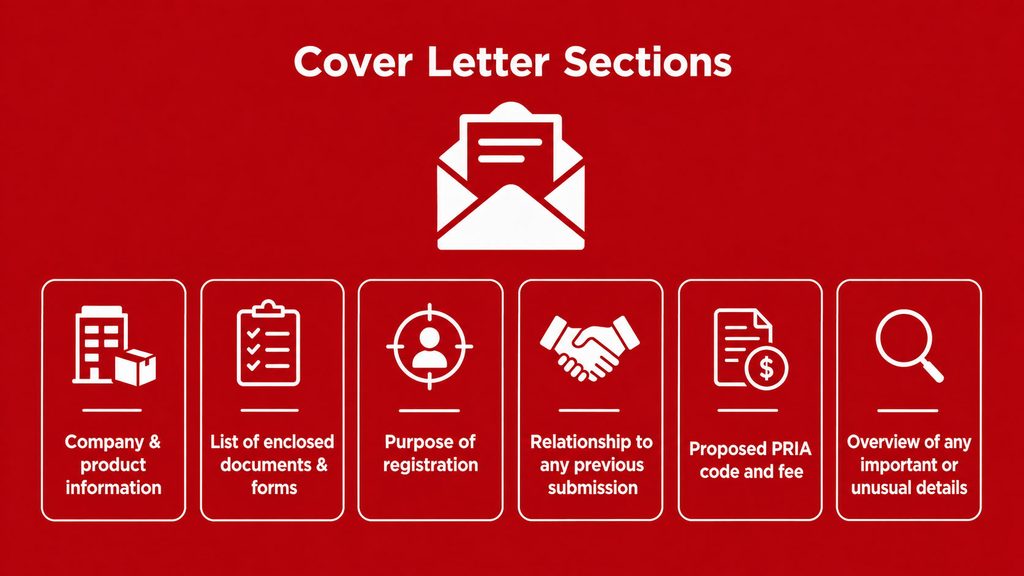
The letter typically opens with your company and product information and the purpose of the application.
It then lists the enclosed documents, notes the proposed PRIA code and fee, and describes how the submission relates to any earlier one.
Finally, it flags anything unusual a reviewer should know about, such as an uncommon ingredient source.
This cover letter is completely optional, and for simple, routine submissions, it can add little.
However, it becomes worthwhile when your package has context that is not obvious from the forms alone.
Cases where a letter helps include:
- Identifying the reference product for a “me-too” submission
- Explaining unusual sources or percentages in the formula
- Describing new uses, use rates, or other changes
In essence, the cover letter is a short narrative that answers the questions a reviewer would otherwise have to ask, which can reduce back-and-forth later. When your submission is anything but routine, it is worth the effort.
Data Portion of an Application Package
With the paperwork in place, we move to the data portion.
This is where you demonstrate, through scientific studies, that your product performs as claimed and can be used without unreasonable risk.
In general, the EPA requires data because it must independently confirm that a pesticide meets federal safety standards before it can be sold.
The studies give the agency the scientific basis to evaluate a product’s potential effects and to write appropriate precautions on the label. That evaluation focuses on protecting several categories, shown below.
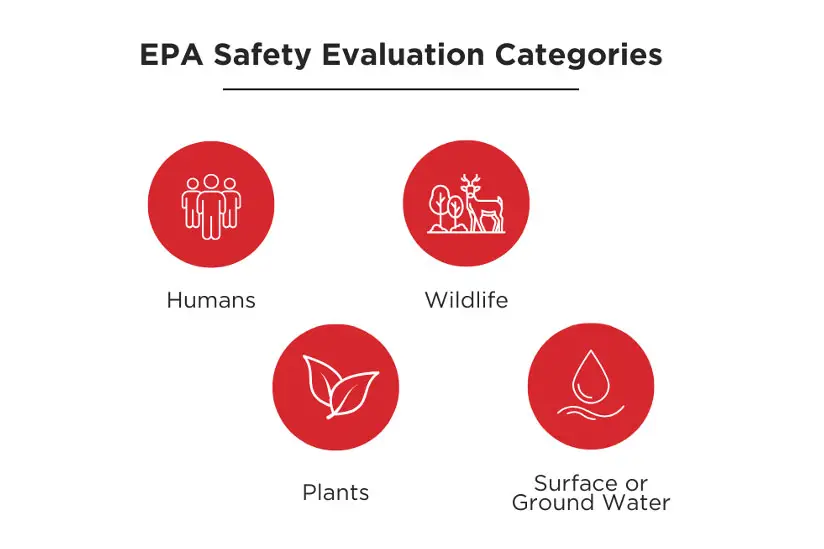
The data you provide is comprehensive because a single study rarely answers every question the agency has.
Taken together, the required studies describe what the product is, how well it works, how it behaves in the environment, and what happens to the people, organisms, and any resources it may reach.
The main required data categories are shown below.
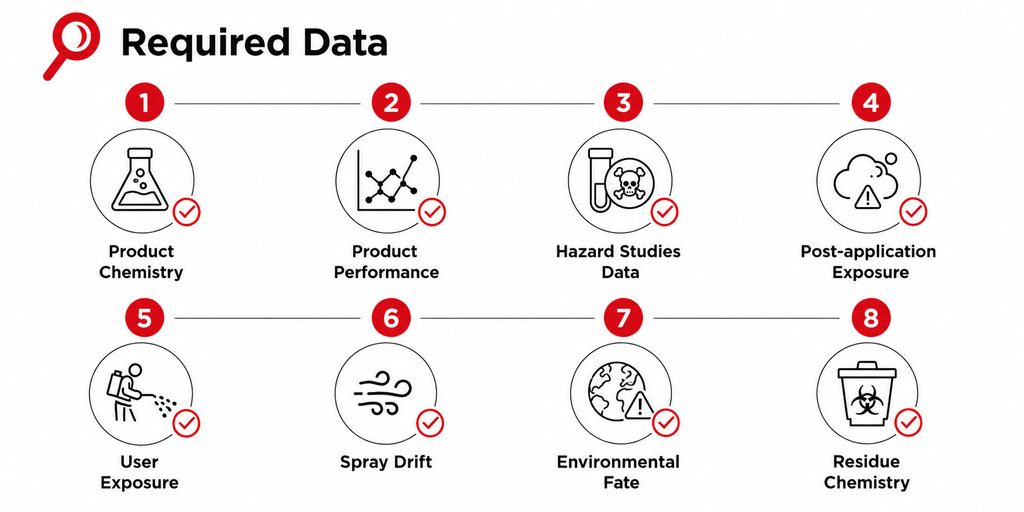
Most of these apply to every product you’re registering.
Others are conditional depending on your submission.
A useful example is product performance data for conventional pesticides.
Under 40 CFR 158.400(e)(1), you must generate efficacy data for any pesticidal claim, but you generally only submit it when the product makes public health claims, such as a disinfectant or a product controlling pests that transmit disease. There is also data related to how hazardous your product is, for which specific studies are necessary.
For each of the two types, different studies apply depending on how soon effects appear and how long exposure lasts.
Acute studies look at hazards shortly after a single exposure, while subchronic and chronic studies examine what happens after repeated or prolonged exposure.
All in all, which data categories you need to cover in your registration depends on your product and its intended use. The practical takeaway is to map the pesticide use pattern against these data requirements early on.
Don’t Forget About Label Requirements
The label is a legal document that carries the instructions and warnings the EPA approves, and it must be part of your submission.
Pesticide labels should always include a defined set of elements, shown in the next illustration.
Together, these tell the user what the product is, how to use it safely, and how to respond if something goes wrong.
The main warnings and directions for use all appear here, alongside the identifiers that tie the product back to its registration record.
That said, there are things to avoid on a label.
The EPA holds registrants to what it has approved, and statements that stray from that can render a product misbranded. Some specific labeling don’ts are shown below.
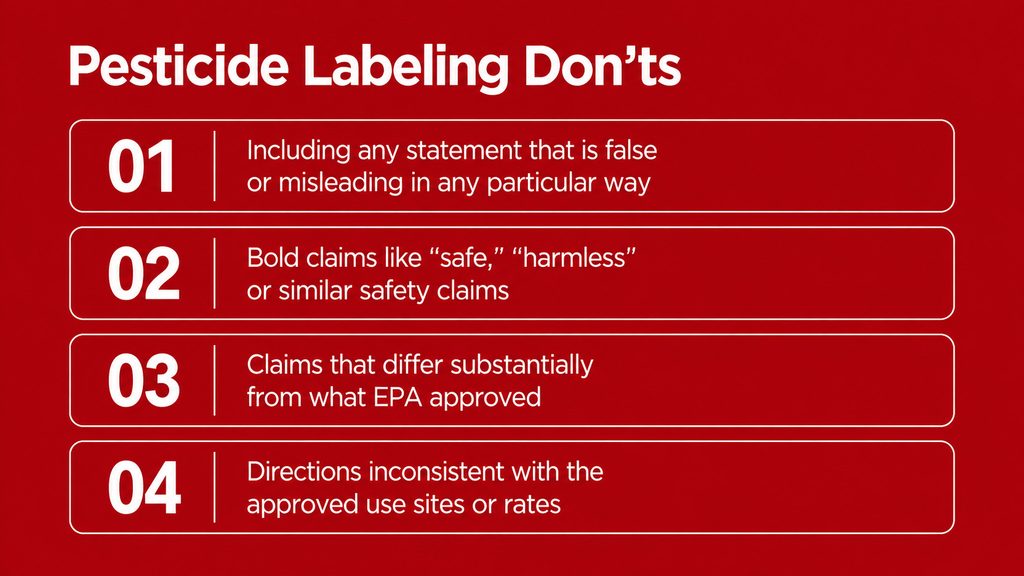
The main thing is to stay consistent with your registration.
Whether during the initial review or after approval, careless statements create risk.
Before approval, an inconsistent label can stall your application. After approval, the same problem becomes a compliance matter, and enforcement can follow.
Submitting the label itself is very straightforward and can be done electronically.
A new pesticide registration calls for a text-based PDF of the label on a CD, along with a signed certification regarding label integrity.
Refer to the EPA’s official specifications for detailed formatting requirements to ensure your electronic files are fully compliant and ready for review
In short, after ensuring the label is built for compliance and matches the registration claims, it’s then included in the overall application package.
Preparing for What Comes Next: Monitoring Regulatory Developments After Submission
Once a product is approved, a set of ongoing responsibilities begins, and the EPA continues to expect action from you.
The main obligations to monitor include:
- Annual maintenance fees
- Adverse effects reporting
- Establishment reporting
- Recordkeeping requirements
- Labeling updates
- Compliance with any registration-specific conditions
Each carries its own routine.
Some run on a fixed annual schedule, while others are triggered by events, such as new information about a product’s risks or a change the EPA asks you to make.
Either way, a registration is something you maintain rather than something you file once.
You also need to account for re-registration needs and for regulatory changes that may affect your product.
On the enforcement side, Alan Sachs and Jack Zietman of Beveridge & Diamond explain how the EPA counts violations.
As noted in their article, if you hold a number of pesticide products, penalties can be assessed separately and add up quickly.
The EPA reviews every registered pesticide at least once every 15 years, and it can request additional data along the way.
Failing to keep up can be costly, and the penalties can compound across a portfolio.
The difficulty is that monitoring is a demanding, continuous process.
Rules shift in ways that are easy to miss, and a change that looks routine can carry real consequences.
For instance, consider this proposed labeling change.
It revises an earlier framework from 2011, and at a glance you might assume it is business as usual.
Look closer, though, and it changes how risks must be communicated to users, which is exactly the kind of shift a registrant cannot afford to overlook.
This is where Knowtify helps.
Knowtify is an EPA pesticide registration intelligence platform that provides real-time access to federal and state-level registration data, product registrations, and labels, so compliance tracking stays manageable.
Our system’s proactive alerts notify you about regulatory changes and product updates as they happen.
With Knowtify, you can build a saved search around an active ingredient, an EPA registration number, a use site, or a competitor’s portfolio, then let the notifications come to you instead of running the same queries every week.
State-level activity is where this matters most, since watching each participating state registry by hand is where things tend to slip.
Ultimately, your team stays current with less effort, and the tracking lives in the system rather than with whoever happens to be running the searches.
Conclusion
That covers what belongs in an EPA pesticide registration application package.
Requirements vary by product, but the underlying principle is that a complete, consistent submission moves through review faster than one that a reviewer has to send back. Prepare each piece of the package carefully, plan for the responsibilities that follow approval, and the process becomes more predictable.