
Key Takeaways:
- Bringing a new active ingredient to market averages $307 million and 11.4 years.
- Reduced risk status could help you cut down processing time by more than 50%.
- Most delays come from minor oversight and are easily avoided.
Getting a new active ingredient approved by the EPA can take years. Sometimes over a decade.
No wonder. New chemistries need real scrutiny before they reach a field, a shelf, or a home.
But a lot of that time can get lost to avoidable mistakes: missing data, skipped meetings, applications that stall for reasons a little foresight could’ve easily caught. Today, we’ll walk you through what actually speeds that process up, and where most applicants trip over their own feet.
Be Mindful of Differences in Data Requirements Between the EPA and Other Regulatory Regimes
Most of the science behind a pesticide doesn’t change depending on which country you’re registering in.
Toxicology is toxicology. A chemical’s potency and potential to wreak havoc doesn’t shift at the border. That’s why the EPA and Canada’s PMRA run joint reviews on many submissions, sharing data and even harmonized product chemistry templates to speed up dual approval.
But “most” isn’t “all,” and the gaps tend to catch applicants off guard.
Take crop groupings, for instance.
The EU, Canada, and the U.S. all sort crops differently for setting tolerances, so data generated for one region’s version of “leafy vegetables” won’t always map cleanly onto the EPA’s own groupings under 40 CFR 180.41.
Environmental and field assessments follow the same pattern, along with ecotoxicology studies on non-target species and the risk models used for food and water exposure.
The underlying data often transfers. The specific study built around it often doesn’t. But that’s not where the potential issues stop. The EU restricts substances based on intrinsic hazard, full stop, regardless of how much real-world exposure actually occurs.
The EPA works the other way around.
It weighs hazard against exposure, meaning a substance can clear U.S. review by showing exposure stays low, in cases where the EU would flag it purely for being hazardous in principle.
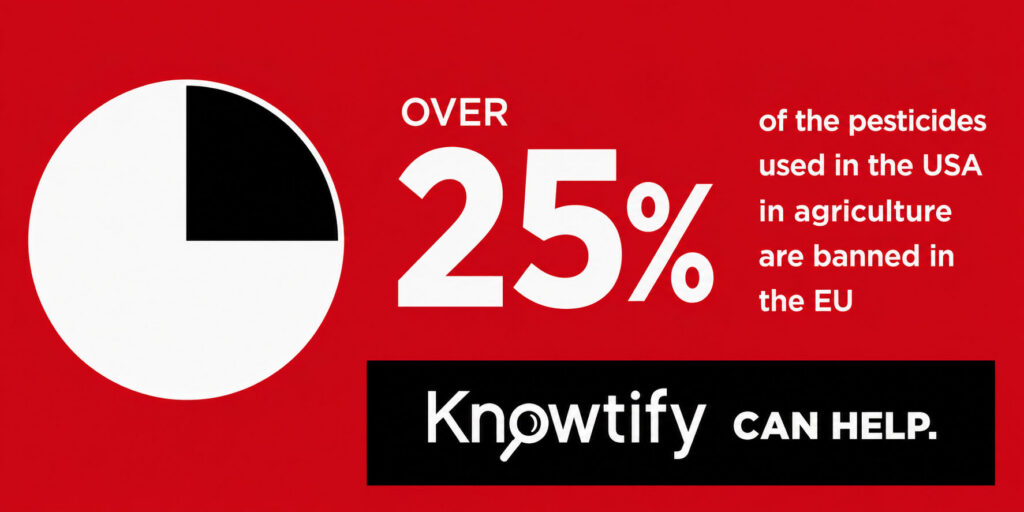
To illustrate this by means of an example, a peer-reviewed comparison of pesticide approvals across the US, EU, Brazil, and China found 72 pesticides cleared for use in American agriculture that are banned or being phased out in the EU. In fact, EU-banned substances account for more than a quarter of all agricultural pesticide use in the U.S.
Here’s the takeaway.
For companies that wish to expand distribution beyond the U.S. is that your budget, both monetary and temporal, should account for carrying out a handful of EPA-specific studies you can’t simply reuse from another jurisdiction’s dossier. No matter how complete that dossier already is.
Ensure You Have All the Necessary Data
The EPA doesn’t work off a single, universal checklist.The data requirements live in 40 CFR Part 158, and the agency groups them by what they’re actually testing for:
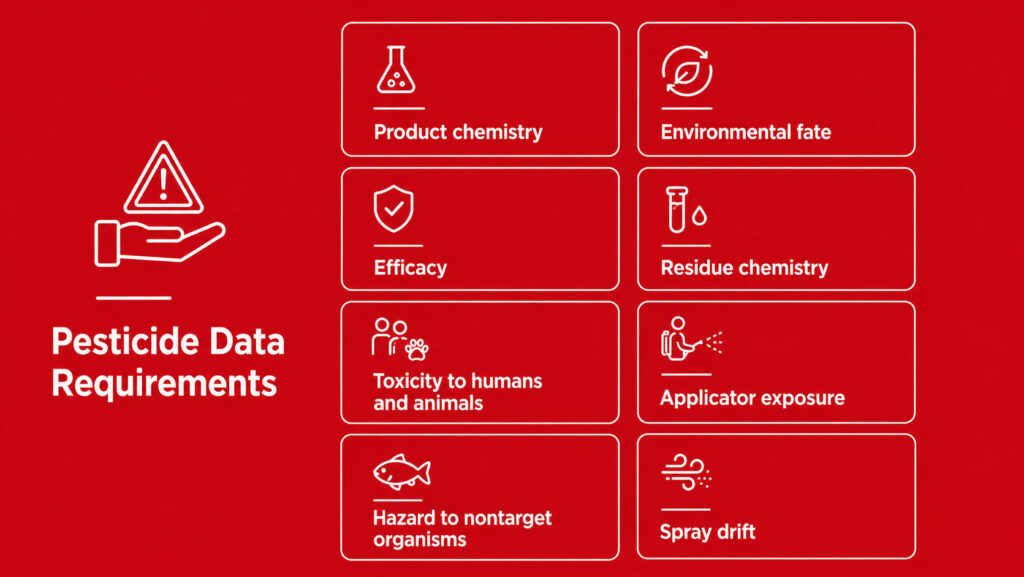
Toxicity testing alone breaks down further into what EPA calls “the six-pack”:
- Acute oral, dermal, and inhalation toxicity
- Primary eye and dermal irritation
- Dermal sensitization
Out of the many criteria and subcriteria, if you make just one mistake in the process, you may inadvertently stall everything for up to three months.
But the complications may not end there if you don’t fix it fast enough.
The clock actually starts ticking before EPA even gets to the science. Within 21 days of receiving your application, EPA runs a Content Screen just to confirm the basics:
- required forms are signed
- labeling is attached,
- data is formatted correctly
- the fee is paid
Common reasons applications fail here include missing signatures, missing data or an unacceptable scientific rationale in its place, and citing inert ingredients EPA hasn’t approved.
Fail to fix these in time, and EPA rejects the application outright, keeping 25% of your fee for the trouble.
After that, you move to the Preliminary Technical Screen on every application – the deeper check on whether your data and information are complete enough to support a decision.
The timeline here lasts 45 days for actions with a review period of six months or less, and within 90 days for longer ones.
If your submission comes back with deficiencies past this point and you can’t fix within 10 business days (or submit a fix and get rejected again), you may be eligible for a refund of up to 75% of your fee.
The upside: EPA offers pesticide-type-specific checklists (conventional, antimicrobial, biopesticide) built specifically to catch these gaps before you submit.
Running your application against the right one first is a lot cheaper than restarting the 45 or 90-day clock.
Thoroughly studying and conforming to all necessary requirements also relieves the EPA’s already stretched resources.
Independent legal analysis of the EPA’s own 2025 operational reports found the Office of Pesticide Programs’ staffing has dropped from over 600 positions in FY 2021 to an estimated fewer than 500 by FY 2025, a decline of more than 15%.
With fewer reviewers, there’s less room for an application to sit in someone’s queue, and what does get stuck there will not be released for that much longer. Do your due diligence, and you’ll save yourself from completely preventable headaches.
Schedule a Pre-Application Meeting With the EPA
Before you assemble a single page of your application, talk to the people who’ll be reviewing it.
The EPA explicitly recommends applicants request a pre-application meeting before submitting anything involving a new active ingredient, a significant new use, or a new technology, by emailing the relevant division’s ombudsman directly.
| Pesticide Type | Division | Contact |
| Conventional | Registration Division (RD) | Various contacts (check EPA contacts page) |
| Antimicrobial | Antimicrobials Division (AD) | OPP_AD_Ombudsman@epa.gov |
| Biopesticide | Biopesticides and Pollution Prevention Division | BPPDQuestions@epa.gov |
The point is simple: get uncertainty out of the way early.
These meetings are where you confirm exactly which data requirements apply to your specific product, discuss appropriate testing methodologies, and clarify labeling expectations, all before you’ve spent money generating the wrong study or missing one entirely.
However, to make the meeting worth the EPA’s time and yours, you have to come prepared.
Typically, they will expect a list of the data requirements you believe apply, any waiver requests you plan to make with a brief justification for each, and more. As for the timeline, the EPA generally schedules these meetings within 6 to 8 weeks from your request, so factor that lead time into your planning rather than reaching out the week before you intended to submit.
Find out if You Should Apply for Reduced Risk Status for Your Active Substance
Not every active ingredient gets treated the same by the EPA.
The Conventional Reduced Risk Pesticide Program exists specifically to fast-track ones that pose less risk than what’s already on the market.
To qualify, your pesticide needs to do at least one of the following:
- reduce risk to human health
- reduce risk to non-target organisms
- cut the potential for contaminating groundwater or surface water
- strengthen integrated pest management strategies
Meeting just one is enough.
The upside is real, and definitely worth striving for. Even the time savings alone are dramatic.
In the years right after the program launched, a standard new conventional pesticide took an average of 38 months to register.
Reduced-risk pesticides in that same window averaged just 14 months.
Even with today’s stricter, health-based standard for tolerances, which requires extra scrutiny, reduced-risk submissions still average around 17 to 18 months.
Beyond the truncated timeline, reduced risk status also gets you:
- Expedited joint review under the US-Mexico-Canada Agreement
- Faster maximum residue limit reviews through Codex Alimentarius
- Preferential treatment from California’s pesticide regulator
Companies can’t put “reduced risk” directly on a label, but plenty use the designation as a marketing point regardless, and buyers of treated crops often prefer it.
Applying means submitting a written rationale alongside your Section 3 application, addressing your chemical’s health effects, environmental fate, other hazards, and pest resistance management.
The EPA typically schedules a committee meeting about a month after receiving your request, where your team gets 10 to 15 minutes to present the case before fielding questions. If the EPA denies the request, you get 30 days to submit a written rebuttal before the decision is final.
Consider Hiring a Consultant
FIFRA/EPA compliance isn’t something you have to figure out alone.
Alexandra Dunn, President and CEO of CropLife America, puts standard EPA review alone at three to five years, with state-by-state licensing adding roughly six months on top, once federal approval is in hand.
Regulatory consulting firms exist specifically to help companies through this process, and their work covers more ground than most applicants expect.
That typically includes:
- defining the right regulatory strategy from the outset
- classifying your product correctly
- identifying data gaps
- justifying waiver requests
- preparing submission-ready application packages
Some also handle the more specialized corners, like data compensation disputes or coordinating registrations across all 50 states.
The case for hiring one is strongest when a registration is complex or genuinely new.
Independent industry research puts the average cost of bringing a new crop protection active ingredient to market at $307 million, spanning 11.4 years, with the regulatory approval and registration process alone accounting for $35 million of that total.
A consultant’s job is to keep that $35 million line item from growing further by catching data gaps, waiver opportunities, and classification mistakes ahead of time.
The case against is mostly about scale.
If you’re filing a straightforward “me-too” registration for a product substantially similar to something already approved, a consultant’s fee may cost more than the problem it’s solving.
Most firms won’t publish flat rates since project scope varies too much, but many offer a free preliminary assessment before you commit, covering data needs, likely costs, and a realistic timeline. That’s worth taking them up on before deciding either way.
Stay on Top of Any Emerging Regulatory Changes
Getting a new active ingredient approved isn’t the finish line.
EPA and its supporting regulations keep evolving, and a chemical that clears registration today can face new requirements a few years down the road through registration review, label amendments, or data call-ins.
Staying ahead of that isn’t optional if you want to keep selling.
Missing an update to your active ingredient’s status, or a change to what your label is allowed to claim, can put your registration at risk just as easily as a mistake made during the application. That’s exactly the gap we built Knowtify to close.
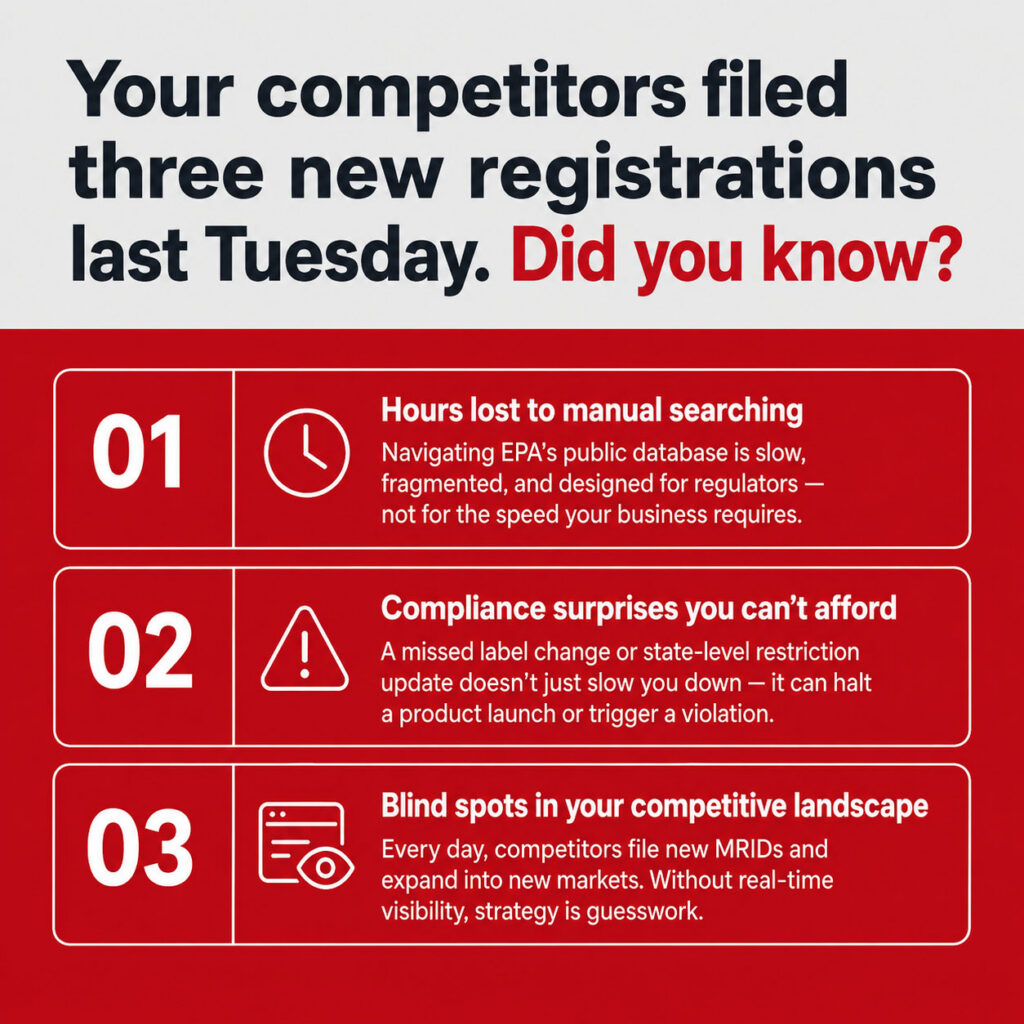
Navigating the EPA registration data has historically meant piecing information together from scattered sources, each with its own format and update schedule.
Knowtify consolidates federal and state pesticide databases into one searchable platform, giving you real-time access to product registrations, labels, and company records without requiring you to do the manual legwork.
Set up your profile around your active ingredient, product, or company, and you’ll get notified the moment something changes.
No more finding out about a regulatory change after it’s already affected your product – with our features, you gain a lot more intuitive clarity.
Why rely on us?
Because having a system that flags changes automatically means your team spends less time on monitoring, admin, and reporting, which they can devote to more pressing tasks, while eliminating any doubt about crucial updates slipping through the cracks.
Conclusion
Getting a new pesticide chemical approved isn’t quick, and it was never going to be.
But the delays that hurt most aren’t the ones the EPA causes.
They’re the ones you cause yourself: a missing study, a skipped pre-application meeting, a regulatory change you didn’t catch in time.
Plan for the differences between regimes, get your data house in order early, and lean on the resources built to help, whether that’s an EPA meeting, a reduced risk application, a consultant, or a platform like Knowtify. Do that, and the process shifts from a confusing maze to a simple and intuitive checklist.